
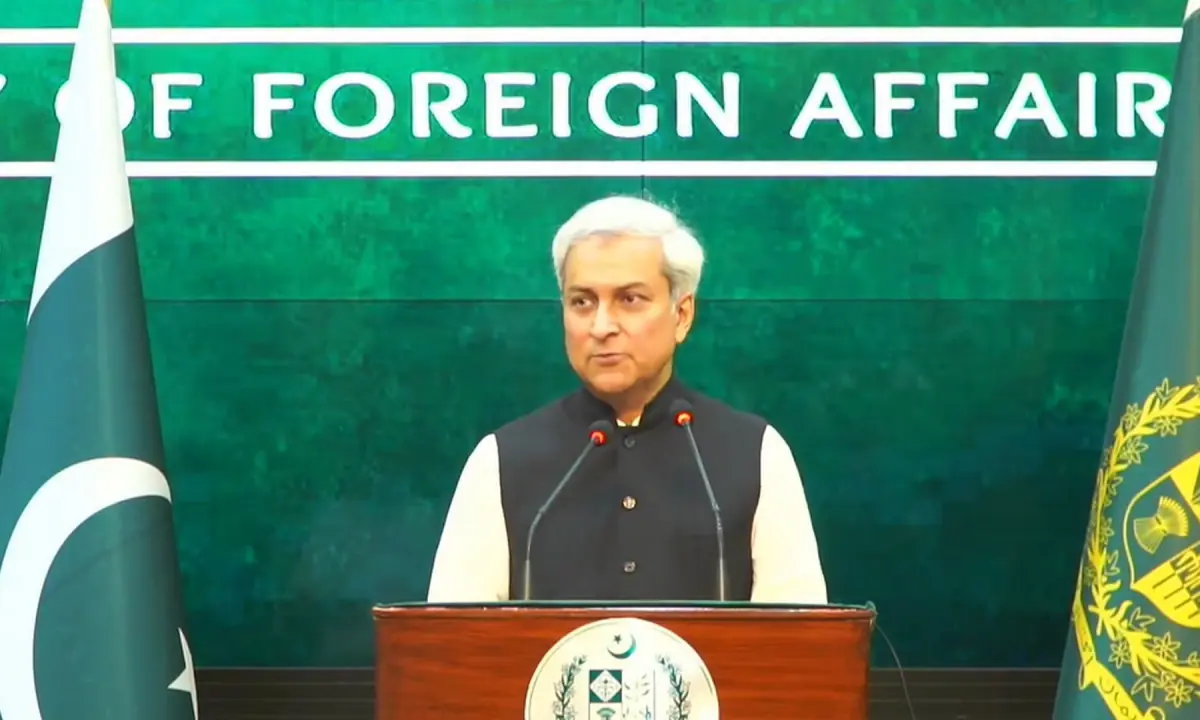
Foreign Office (FO) spokesperson Tahir Andrabi said on Thursday that Pakistan was playing the role of a “bridge builder” during the ongoing US-Israeli war on Iran.
The war began as the US and Israel launched strikes on Tehran on February 28, which also resulted in the assassination of Iranian Supreme Leader Ayatollah Ali Khamenei. In retaliatory strikes, Iran has targeted US assets and bases in Gulf countries, against which a resolution was adopted in the United Nations Security Council on Wednesday.
Meanwhile, Pakistan has been calling for de-escalation, with Prime Minister Shehbaz Sharif and Deputy Prime Minister and Foreign Minister Ishaq Dar holding phone calls with dignitaries from relevant countries over the past few days.
On Thursday, Andrabi gave a round-up of the phone calls during his weekly press briefing. During the question-answer bit, a reporter mentioned that Dar had previously spoken about Islamabad “shuttling communications between Tehran and Riyadh to try to ease tensions”.
“Has that been Pakistan’s role between Tehran and any other country?” the FO spokesperson was asked.
In response, Andrabi said: “ As regards the communication that we may have between Iran, Saudi Arabia, and other Gulf countries – yes, we have had an open channel of communication.”
He then recounted the phone calls that PM Shehbaz and Dar had held with dignitaries in other countries, saying “there is a level of exchange of communication”.
“We are playing the role of a bridge builder. Our principal position on issues regarding sovereignty, international law and the UN Charter, and on dialogue and diplomacy, is respected in all regional capitals. So, this allows us to exercise a channel of communication between the relevant capitals,” he added.
Responding to other questions on this matter, he reiterated that Pakistan had “undertaken a high-level exchange between relevant states”, and added that Islamabad’s engagements with the US also continued.
“There are various levels of engagement. You may recall that the foreign secretary had a telephone conversation with the US under secretary of state. Various other levels of diplomatic engagement continue with the US, and we will keep you updated on these developments as and when they happen,” Andrabi said.
He also mentioned that Pakistan had been “in touch with the State Department through our embassy in Washington. The US embassy here is also in touch. So, yes, these dialogues are ongoing”.
The FO spokesperson also said that PM Shehbaz had held a phone call with Iranian President Masoud Pezeshkian on Wednesday and exchanged Ramazan greetings.
“The prime minister offered condolences on the martyrdom of Ayatollah Ali Khamenei,” he said, adding that in a follow-up to his letter to Mojtaba Khamenei — who has been elected the new supreme leader of Iran — the prime minister congratulated the Iranian president on Mojtaba’s assumption of this “onerous responsibility”.
PM Shehbaz expressed hope that Iran would enjoy peace, stability, dignity, and prosperity in the years ahead, Andrabi added.
The FO spokesperson was also asked about Pezeshkian’s post on X on Wednesday, in which the Iranian president outlined the conditions for ending the war.
“The only way to end this war — ignited by the Zionist regime and the US — is recognising Iran’s legitimate rights, payment of reparations, and firm international guarantees against future aggression,” Pezeshkian said in his post.
Andrabi said that “we took note of it as an ongoing discourse”.
“This is what diplomacy is, that you discuss all these issues. The audience of the tweet from the Iranian side is international, and everybody is aware of these conditionalities.
“So, of course, when you talk about a situation, all issues are discussed. As regards in what precise way these issues are discussed, these are, you know, part of diplomatic exchanges, and frankly, I am not privy to any of those at this stage,” he added.
The matter of the disruption of traffic through the Strait of Hormuz, which has triggered a fuel crisis, also came up during the briefing, on which Andrabi said: “I can confirm that we were in touch with Iran with respect to the passage of Pakistani ships through the Strait of Hormuz.”
Andrabi also clarified that a delegation visiting Afghanistan, reportedly to hold talks with the Afghan Taliban, was not an “official effort”.
“I would not try to, sort of, underestimate or minimise the importance of this visit, but let me tell you that this visit certainly is not part of any official efforts. These individuals, the leader of the delegation, and their visit to Afghanistan – all details we are not aware of. They are in a non-official capacity from our perspective,” he said.
In response to a query about China reportedly “shuttling between Kabul and Islamabad” amid tensions remaining high, Andrabi acknowledged that Dar had held a phone call with Chinese Foreign Minister Wang Yi, stating that “Pakistan and China cherish a long-standing strategic partnership, founded in mutual trust and deep respect”.
“We enjoy unanimity of views on all issues, including with respect to Afghanistan. As you know, we are engaged in a dialogue process on Afghanistan. Afghanistan features both in our bilateral dialogue as well as in our trilateral dialogue framework,” he added.
He also confirmed that Chinese Ambassador Yue Xiaoyong was visiting Pakistan and hoped to have “productive discussions with the Chinese side on our shared concerns, particularly on terrorism emanating from Afghanistan”.
But, he expressed a lack of knowledge about any Turkish delegation visiting Pakistan, reportedly to broker a ceasefire between Islamabad and Kabul.

No comments yet. Be the first to comment!
.png)
Your trusted source for breaking news, in-depth analysis, and comprehensive coverage of today's most important stories.
Get daily updates on breaking news, exclusive interviews, and special features delivered to your inbox.
Have a news tip or want to get in touch with our editorial team? We're here to help.
Silicon Valley, California, USA