
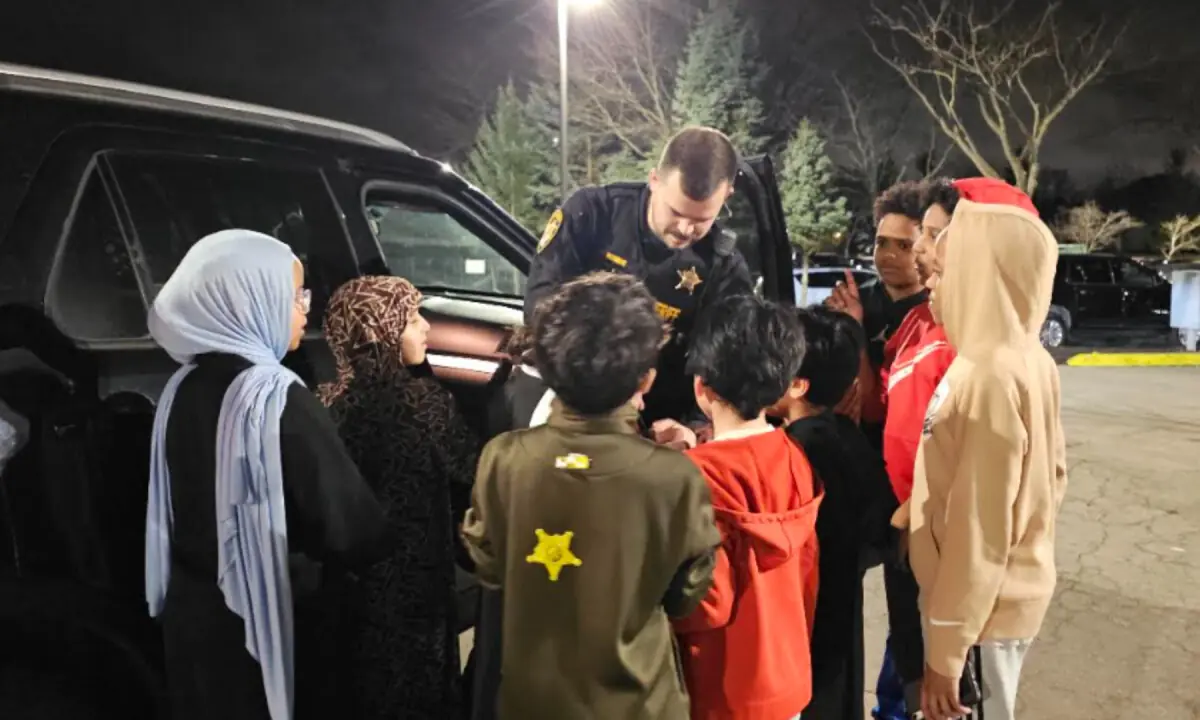
Outside a mosque in Hilliard, Ohio, a police officer stood in the cold night air, handing out candies and stickers to children while their parents prayed taraveh inside.
Hilliard, a quiet suburb near Columbus, the state capital, is home to a growing Muslim community. At its centre stands Masjid-i-Noor, a striking modern structure whose wide glass frontage glows softly after sunset.
Smaller mosques also serve the area, including Masjid as Shurooq, where the North American Indian Muslim Association (Naima) hosted an iftar dinner for a small group earlier in the evening.
Many who broke their fast there later drove a few minutes to join the larger taraveh congregation at Masjid-i-Noor — a reminder that in a small town, distances are short and communities are closely knit.
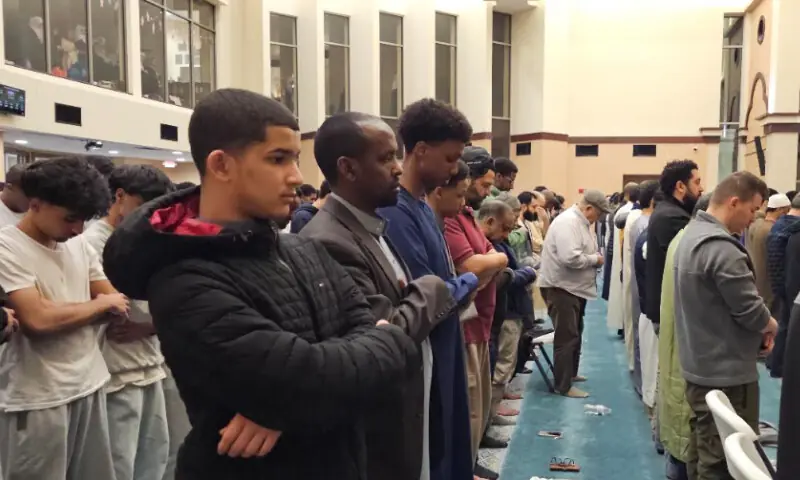
Inside, worshippers raised their hands in dua, praying for an end to war and for peace in a troubled world. Outside, beneath the glow of parking-lot lights, a uniformed officer smiled at their children, offering sweets and stickers — a small gesture that quietly reflected the ease of coexistence in this Midwestern town.
The mosque’s spacious interior includes a large multipurpose area where children played a casual game of American football, rode small bicycles and clustered in animated groups after Maghrib and Isha prayers, while their elders stood shoulder to shoulder in long rows for taraveh.
“We make a conscious effort to keep the mosque welcoming for children,” said Dr Mahmood Khan, a cardiologist and head of Naima. “If they feel at home here, they will remain connected to their faith. The aim is not to silence them, but to guide them.”
In a brief address during a pause in the prayers, he gently reminded teenagers to respect the sanctity of the mosque while enjoying the open space.
Dr Khan said Naima focuses on broader community engagement, including healthcare initiatives, orphan support and small self-employment assistance. “Our responsibility extends beyond our own community,” he said.
Local Muslim groups regularly organise food distribution drives across Ohio and hold free medical clinics. “Most of those who benefit from these services are non-Muslims,” noted Shakil Saghir, an active member of the Hilliard Muslim community.
For younger volunteers like Yahya Mahmud, Ramazan is both a spiritual and organisational challenge. “Ramazan brings hundreds to the mosque every evening,” he said. “The real work begins after it ends — keeping young people engaged throughout the year.“
Muhammad Saifuddin, a university professor, observed that many Muslim families in Hilliard are highly educated professionals. “It is a peaceful place to raise children,” he said. “Here, they learn to appreciate the best of both Muslim and American traditions.”
In smaller American towns, there is often a simplicity in human interaction that feels increasingly rare in larger cities.
As the taraweeh prayers concluded and families stepped back into the cool Ohio night, children clutched their candies and stickers — small tokens of a kindness that required no translation.
Header image: A police officer distributing candies among children, while their parents are praying taraveh inside the mosque. — Author

No comments yet. Be the first to comment!
.png)
Your trusted source for breaking news, in-depth analysis, and comprehensive coverage of today's most important stories.
Get daily updates on breaking news, exclusive interviews, and special features delivered to your inbox.
Have a news tip or want to get in touch with our editorial team? We're here to help.
Silicon Valley, California, USA